I am not going to waltz around it. Finding out who Matilda Hall is will not seriously change the course of world events. It is an historical problem that is only a concern to people researching the various Hall families, people researching Hopkins families, and descendants trying to research their full ancestry.
And it is also a problem we have not yet solved. None of the existing genealogies we have inspected include any identification of her parents. This article wishes to lay out the facts that we know now and suggest ways to solve the mystery of Matilda.
This story takes place in the early 19th century in New Hampshire and Vermont. As Massachusetts had started to get crowded, many families pulled up stakes and headed, north and west – going east was not much of an option and south into Connecticut and Rhode Island was not a reasonable option.
Our tale starts out in what is called the Upper Valley of New Hampshire where Matilda Hall was born about 1803, supposedly in the town of Claremont as we will learn from a later record. The towns of Newport, Lebanon, Croydon, etc. in New Hampshire and towns of Springfield, White River Junction, Windsor, etc. across the Connecticut River in Vermont were expanding rapidly. I have identified at least 3 or 4 different biological Hall families that began settling there in the early 19th century. Unfortunately, the town record keeping was not very systematic, and so far I can find no record of her birth.
And, of course, as is the story across the United States, as people move in, the viable Upper Valley land was gobbled up and land prices went up so some people moved on. One of the places they moved was north into Vermont.
Our first siting of Matilda is in 1826 when she marries John Turner Hopkins (1799-1876).
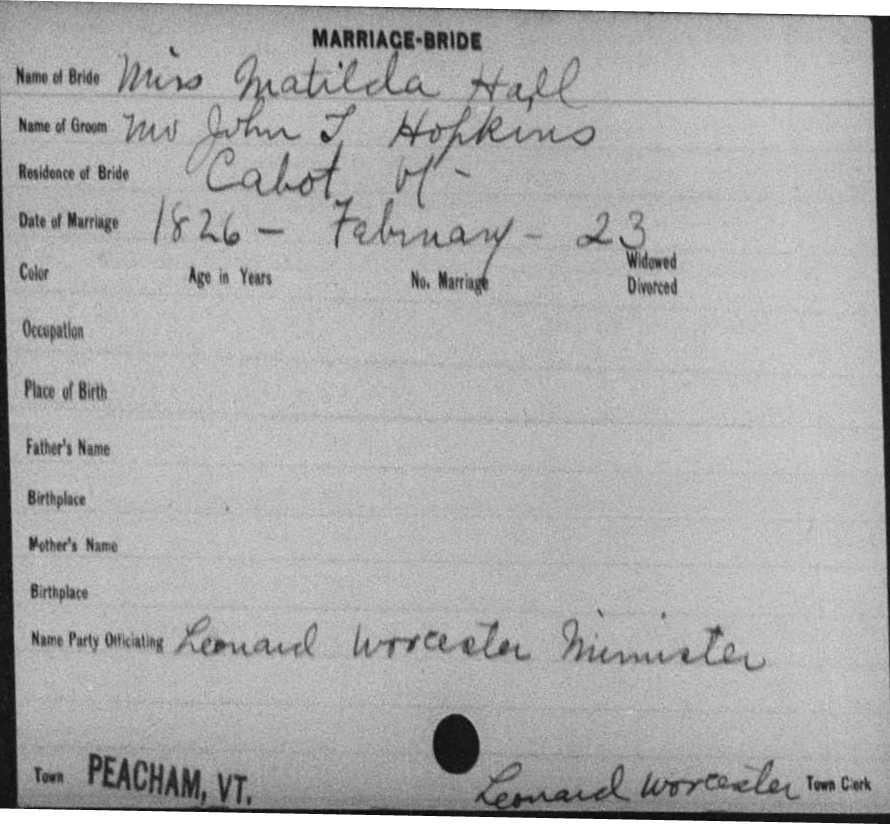
From this record, we learn that Miss Matilda Hall was living in the town of Cabot, Vermont. This Washington county town is now best known for its superior Vermont Cheddar Cheese. And it is an arduous 90 miles north of Claremont. The Hopkins family was living in the Caledonia county town of Peacham where their marriage was recorded. If you look at a map (something I always advise when working on a genealogy…), you will see that Peacham is a neighboring town, about 11 miles southeast of Cabot across some seriously hilly terrain.
Let me tell you about her husband John Turner Hopkins. He was a son of Stephen Hopkins and Nancy Hyde Turner and was born 13 May 1799 in Brookfield, Orange county, Vermont, about 40 miles southwest of Peacham. He is descended from the immigrant John Hopkins who came to Cambridge in the early 1630s and became one of the original proprietors of the Hartford, Connecticut, colony. If – and it is a big if debated by many researchers – he was related to the Stephen Hopkins of the Mayflower, it would have been in England. Some of his other ancestors included Elder John Strong who was a dominant voice in early western Massachusetts and Rev. Timothy Edwards, founder of the US Presbyterian Church, and father of Rev. Jonathan Edwards, a well known pastor of his time. This Hopkins family may not be as famous as the Mayflower Hopkins family, yet it has been a prominent New England family that many take claim to proudly.
But, as I study Halls, I need to answer who Matilda’s parents were and which of the many immigrant Hall families she was part of…
Let us look at the census record…
Surprisingly, John Turner Hopkins does not appear in Peacham in the 1830 census. But he is the John S? Hopkins enumerated in Glover, Orleans county, Vermont about 34 miles north of Peacham. He is listed with 2 sons under 5 which conforms to his first two known children, Henry Bridgeman Hopkins, born 1826, and Stephen Worcester Hopkins born in 1829 and, as reported, in Irasburg, Orleans county, which is about 12 miles northwest of Glover.
In 1840, John and Matilda are back to Peacham where they are listed as having 2 sons ages 10-15; 2 daughters and 1 son ages 5-10 that conforms to Samantha Livingston Hopkins, born 1831 in Peacham, Harriet Elizabeth Hopkins, born 1834, and John Leonard Hopkins , born 1836 in Peacham; and 1 son under 5, George Lester Hopkins, born 1838 in Peacham.
The 1850 census shows I have to do more work to fully document the 9 children. John is listed again in Peacham, and we get to see names for everyone in the family. John is listed as age 45, born Vermont; that was concerning that his age was so wrong, but seeing the names of the children, I was less concerned about whether or not I had the right family. His apparent wife was not Matilda, but an Abigail, age 52, born in New York. This may be a clue or just the worst possible enumeration. Eldest sons Henry and Stephen are not included, but the other children, mentioned above, were listed, but all as born New York; along with Edward Wright Hopkins, born 1842 in Peacham (listed age 10, b. NY); Julius Hubbard Hopkins, born 1845 in Peacham (listed as age 6, b. NY); and Electa H, born 1847 (listed as Ann, age 2, born VT). I need to find Matilda as she might be with one of the sons who was married and helping with new born, and Abigail might be either her sister or John’s sister helping him with his family.
… As I implied above, this is a work in progress that I am writing up now to see if someone else has ideas to solve puzzle… Also, I sometimes find that writing up a problem like I am doing allows us to identify some next steps to take.
The 1860 census is much more reasonable. All of the family are listed as born in Vermont and everyone’s age is listed appropriately. We have John, Matilda, George, Edward, Julius, and Electa. I just now need to find out where the rest of the children are.
The post-Civil War 1870 census shows us that John and Matilda have moved to Groton, Caledonia county, about 14 miles southwest of Peacham and are living there with their son Edward. Matilda is showing that she was born in New Hampshire. Their son John is still living in Peacham, and I will have more to say about him as I document each of the children.
John Turner Hopkins died 13 November 1876 in Groton, Vermont.
After her husband’s death, we find Matilda in the 1880 census back in Peacham, living with her daughter Electa and her husband William H Ash and their son George. In the ultimate irony of this investigation, Matilda recorded that she was born in New Hampshire, as was her mother, but did not know where her father was born.
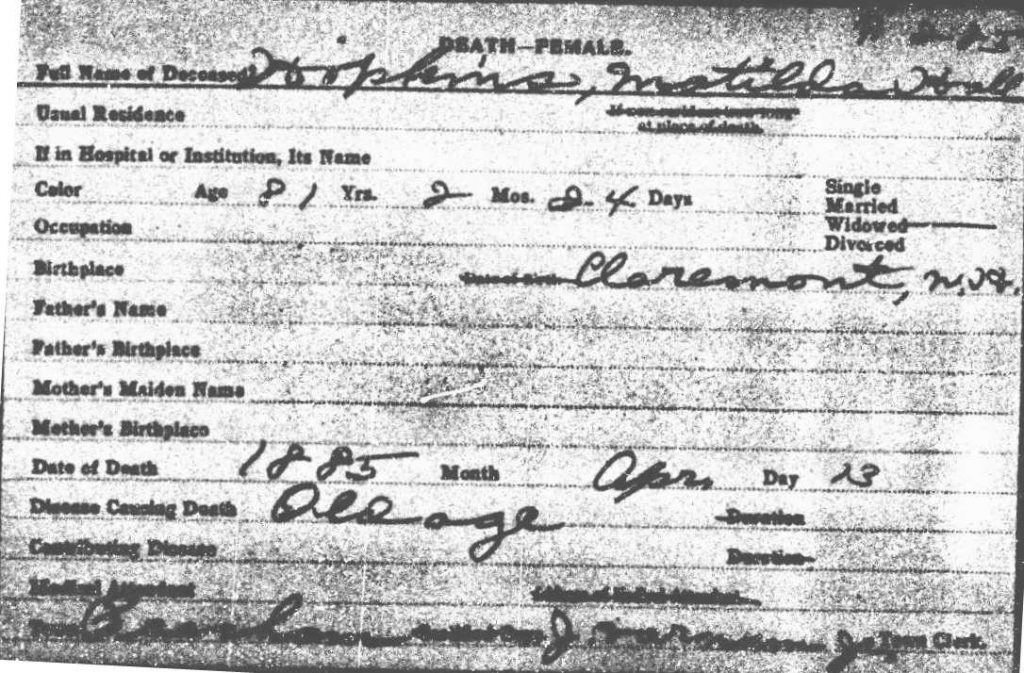
Matilda died 13 April 1885 in Peacham at age 81 years, 2 months, and 24 days of Old Age. She was said to have been born in Claremont, New Hampshire.
I now need to do some “ordinary” paper trail research to see what I can learn about John’s siblings to see if I can find out who Abigail was in the 1850 census, I want to also fully document each of their children to look for clues. I doubt that will be enough to solve this puzzle. What steps can we take?
I see three steps that could be productive.
First, publicize the problem.
It is always possible that some descendant has already solved the puzzle and has just not published their findings. Or someone may have a reference to some source material that has a mention of her family. One new concern when seeing the 1880 census is that she might have been the daughter of an unwed mother which might be why so little has been written of her ancestry. As there were no Hall families in Claremont in 1800 and 1810 census, her mother might have gone there to give birth. Also, there were no Hall families in Cabot, Vermont, in 1820 or 1830 – maybe she was with a married sister or her mother who had remarried.
Second, use one-name study techniques to break through a brick wall.
List all of the Hall families who were in the target locales in the 1800-1830 census and work up their families. This will at least give an understanding of who could have been in the area.
Lastly, use DNA.
As she was born in the 19th century, it is quite possible that an older descendant of Matilda would have enough “Hall” DNA such that an AncestryDNA test (suitably imported to FTDNA, MyHeritage, GedMatch, etc.) might lead to finding some suitable Hall cousins.
My preference is to all of the above, but the DNA is something that needs to be done soon. Ideally, two older Hopkins descendants – one male, one female should get AncestryDNA tested and the male also get a 37 marker or Big Y YDNA test.
This is a work in progress. Please feel free to comment. I will be updating this article as I add the additional data I mention above.

Hi John,
My Hall ancestors came from the Vermont area. I have Asahel Hall b. abt 1786 m. Mary Polly Shutts b. abt 1788 daughter Abigal Hall b. 1825 m. Isiah Harrington Williams b. abt 1827. Asahel father was Asahel Hall b. abt 1746 m. Abigail Barnes b. abt 1750 Connecticut. I’m not sure if this helps. I have been able to find very little documentation to verify. I keep lists to see what comes up.
My direct line comes from George Hall b. 1812 m. Anna Sumner b. 1814, their daughter Helen Anna Hall b. 1839 m. Levi Henry Loucks b. 1837 (Civil War veteran). My mom b. 1939 was a Loucks.
No one in our family carries a direct Hall name. I do have three brothers who could get tested.
Good luck
Colleen Lockwood
Shoshone Idaho
lockwood3c@gmail.com